

Star Wars’ Original Sin Is Buried in the First Film
Darth Vader was dropping bombs but nobody listened

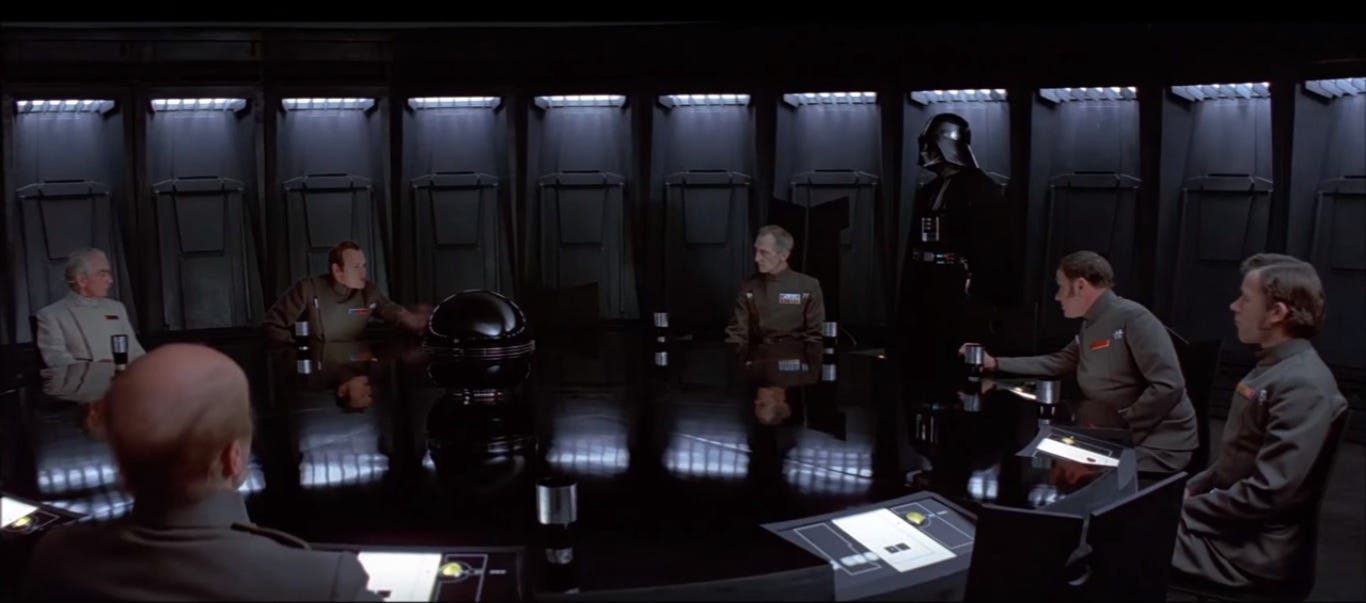
It’s kinda funny that for all the revolutionary things the very first Star Wars introduced—celibate space monks, sounds in space, gay robot butlers—it also included something perfectly at home in both contemporary 1970s America and today: the conference room. Because even when plotting intergalactic genocide, there’s a proper way to do things.
The conference room scene in A New Hope is memorable mostly because it’s the first time we really see what Darth Vader can do. Up until the meeting, he just broods and menaces. In fact—that’s also his initial posture at the meeting. While all the Imperial muckety-mucks are seated around the table, discussing politics and their shiny, planet-killing toy, Vader stands to the side and is just, like, there. Breathing. Literally!
It’s like Grand Moff Tarkin brought Vader for ‘Bring Your Henchman To Work Day’ but doesn’t trust him enough to leave him alone while he’s working, and nobody thought to bring an extra chair. I get it, Tark—when I brought my kids to work, I had to keep them quiet with vending machine trips and targeted raids of the office supplies. Otherwise they’d start making inappropriate statements like, “Daddy, do you just sit on your butt all day,” and, “You don’t seem to be working very hard,” and, “What is this Reddit you keep looking at?”
When Vader finally stirs, it’s to engage in a philosophical disagreement, one he wins by choking out a dude using only his mind and a gesture that frankly seems more performative than necessary. Then again, Vader does walk around wearing a floor-length cape for no good reason other than vibes. Maybe 80% of the Force is showmanship. That would certainly explain this move, which baffles and delights me to this day:
Vader initially breaks his silence with a project update—“The plans you refer to will soon be back in our hands”—because they are in a conference room and that’s how things are done. We can only assume there’s a projector displaying a Gantt chart on the wall, and a side table just off-camera with bagels and carafes of coffee (or ‘caf,’ if you spent your forgone youth reading Star Wars fiction). Then he starts preaching from the gospel of hokey religions.
Vader: Don’t be too proud of this technological terror you’ve constructed. The ability to destroy a planet is insignificant next to the power of the Force.
There’s a lot happening here. I’m going to unpack it briefly.
First, and notably, he speaks… and actually has something to say. Up to this point, every single thing Vader has said has been about the mission or included an exclamation point. Going into the conference room, we have a pretty good handle on the man in black. Ominous Bad Guy, definitely going to die in Act Three. So when he starts getting philosophical, there’s a moment of, ‘wait a minute—what?’ It’s not just the audience. The guys around the conference table seem equally surprised. It’d be like if your cat finished cleaning her butt and then said something about the meaning of life or the futility of working for a living. The surprises compound.
But we skip over all that, because there’s a snivelly brown-noser at the table—no meeting is complete without the dude (it’s always a dude) out to prove he’s the best, most capable person there—who mocks Vader’s ancient religion, necessitating a hands-on, hands-off, demonstration. When the scene concludes, we go away with two clear impressions: there’s more to Vader than black leather and a bad attitude, and space magic is pretty awesome.
That is our lasting impression of the scene. And the Force sampler platter seems to be just a hint of what’s to come. As abilities go, being able to destroy a planet ranks pretty high, above parallel parking but below fixing something at your house and only making one trip to Home Depot. And Vader is saying the Force is even more powerful than that.
All true. But I want to go back to the first part of Vader’s declaration: “Don’t be too proud of this technological terror you’ve constructed.”
First of all, briefly—is Vader a closet bibliophile? The alliteration in “technological terror” is too precise to be random. Maybe he has the Kindle app installed in his helmet and is just reading constantly, and that’s why he’s usually silent. It would also explain why he’s so pissed all the time—nothing is more frustrating than being in the throes of a good book only to get interrupted repeatedly.
I also admire the Amish vibes of “technological terror.” I imagine that’s how they refer to automobiles, when they aren’t calling them horseless carriages or Satan’s wheelbarrow. Vader using that kind of language signals that he’s old school, and as anyone who has grown up and gotten older and watched, mystified, at the stuff tomorrow’s youth get up to, the old ways are the best ways. Usually. As someone who meticulously built a library of VHS movies recorded during the 90s and 00s when I had promotional HBO (a collection I never watched once), being able to stream basically any movie I can think of, at any time, on the couch or in bed or on the toilet, is pretty cool. Less so the idea of paying a stranger to pick up my order at McDonald’s and trust they aren’t going to steal fries or even just breathe on my food. If I’m determined to clog my arteries, I can drive to McDonald’s my own damn self, thank you very much.1
One of my favorite themes of the very first Star Wars film is the tension between the old ways and the new. Spirituality vs technology. Star Wars gradually and then dramatically veered away from this in successive installments. That’s partly the nature of storytelling—the Force in A New Hope seems unknowable because it is. We literally know nothing about it. Each sequel added new powers and new rules. Borders were established. That’s all well and fine.
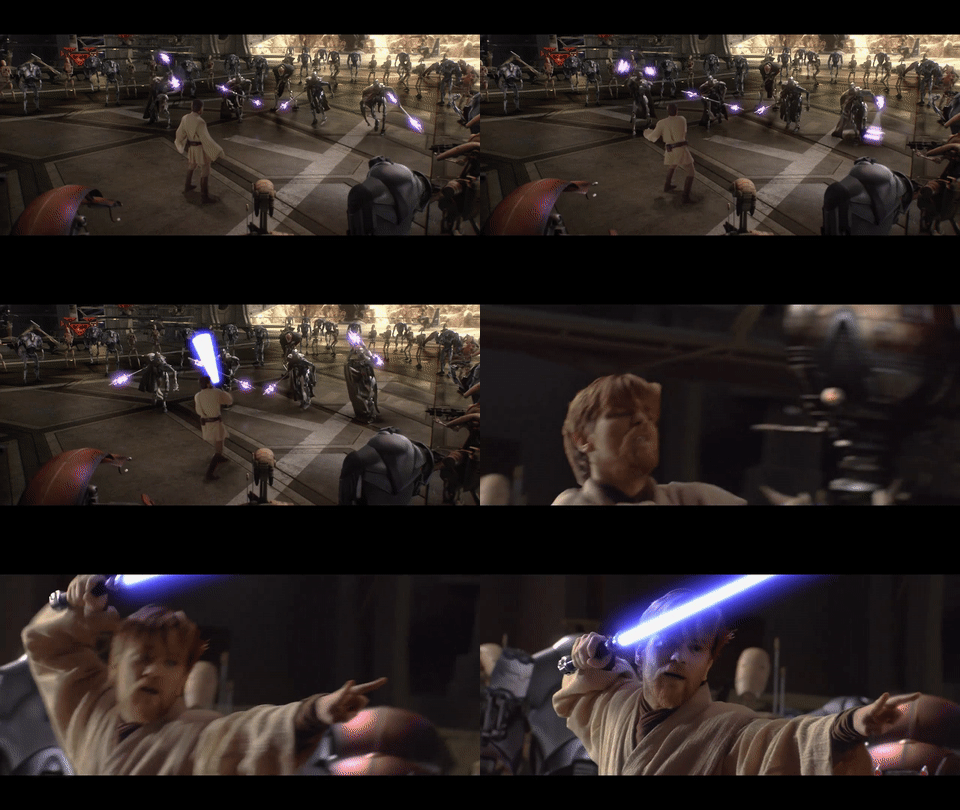
The Prequels obliterated the line between the mysticism of the Force and the gears of technology. Suddenly the Force was something that could be measured, weighed, calculated. It immediately adhered to Arthur C. Clarke’s Third Law: any sufficiently advanced technology is indistinguishable from magic.
The technology in this instance was microscopic blood organisms, something that could (presumably) be manufactured and manipulated because it could be computed. It baffles me to this day that the Prequels dropped this bombshell in the first installment, introduced cloning in the second… and did not do the obvious thing of marrying the two in the third. When a haunted Obi-Wan mentions ‘The Clone Wars’ in A New Hope, that’s the kind of scenario I imagined. Manufactured Jedi wearing the faces of their friends, not a bunch of photocopied proto-Stormtroopers fighting robots.
In a meta sense, Star Wars itself became infatuated with technological terrors. We didn’t even get out of the first trilogy before there was another Death Star—somehow the Death Star returned—bigger and better, I guess, armed and operational, but also not fully baked. George Lucas waited for filmmaking technology to advance to a point that he could make the Prequels, and then the movies themselves primarily became about that technology: CGI on CGI violence, Jar Jar Binks, blue screen cinematography, copy-paste editing.
The Sequel Trilogy gave us Starkiller Base, aka Death Star 3.0. It also introduced new technological terrors, such as bombing squadrons in space, hyperspace tracking, hyperspace skipping, hyperspace kamikazing—basically anything to do with hyperspace—Sith daggers that point to the watery graves of Death Stars (yes, plural, because that is actually the only logical explanation), enormous Sith fleets waiting for the plot to activate them, and Sith Lords who had been atomized and obliterated but still returned, somehow.
Star Wars became too proud of its technological terrors. It largely became about the technology—the Star of it all—and lost sight of something Darth Vader knew from the jump. Star Wars is special because of the thing you can’t see, can’t touch, but has always been there. To misquote a drunk Maverick and Goose trying to run game in Top Gun, it lost that loving feeling.
There is a pressure with new Star Wars to show us something we haven’t seen before. That almost always manifests as new technology, which is usually just a new take on something Star Wars has always had. Not only does that make it derivative, the new thing is always worse. The best Death Star is the first one. The best hyperspace jump remains the first one (the one where Han mocks Luke for being a backwater hick). Even the mysticism of the lightsaber has been chipped away, a gradual but perpetual decline from its Arthurian-like introduction to the double-bladed iteration to the lightsaber porn of the Prequels to the modern day version, which runs people through and somehow they don’t die.
I don’t even know what I want from Star Wars any more. I want it to be good, obviously. Increasingly, I feel like Vader must’ve felt standing around in that conference room, annoyed he had to put down his eBook copy of Eat, Pray, Love because those geezers kept talking nonsense.
“Don’t be too proud of this technological terror you’ve constructed.”
The modern day translation: Stop playing.
We ain’t getting any younger out here.
I used McDonald’s as an example but I couldn’t tell you the last time I’ve been there. Last year maybe? Ditto pretty much any fast food. Not because I’m above it. There just came a point where the price to quality ratio became too skewed. These days I’m more likely to get subs or pizza if we eat out. Taco Bell is the one place I would still happily go.
Of course they were going to listen to him talk- James Earl Jones (RIP) had a speaking voice that was created to command attention...